Revisiting PLE: My Personal Changes This Semester and My Goals for My Future PLE

Hey guys! So I am going to revisit my Personal Learning Environment and see what changes I have made to it this semester and discuss what changes I hope for in the future.

Here is the picture of my previous Personal Learning Environment from the beginning of the semester.

PLE

Image: “Megan’s Personal Learning Environment” by Megan Svara.

Over the course of the semester I have been using the WhatsApp application to communicate instead of FaceTime and Messages. Being in a European country, I had to adapt my forms of communication in order to be able to communicate with others. In Spain, people use the WhatsApp to call, text, and video chat. Therefore, I began to use this on a daily basis to communicate not only with other people in Europe but also my family back home in the United States of America.

Image result for whatsapp

Image: “WhatsApp” by Twitter.

Also, this semester I began to use a site called Diigo. Diigo is a service where you can highlight, compile, and save notes you take on the internet on articles or websites that you read. This semester I had to write a more research papers than normal, and I found using Diigo was extremely helpful because it was an easier and more organized way to conduct my research. I will definitely continue to use this website in the future because of how helpful it was this semester.

Image result for diigo

Image: “Diigo” by G2 Crowd.

This semester I also began my own online beauty, health, and wellness business. As a part of a “work from home” position, I had to be trained by my team lead through some form of technology. Therefore, I found myself using a new application called Zoom. This is similar to Skype, but you can have many people on a call at the same time. This has been super helpful because training is so much easier when it is done verbally rather than written. Being so far from my team lead allowed us to easily communicate this way and I definitely plan to continue to use this form of communication to train my team as it grows in the future.

Image result for zoom

Image: “Zoom” by Skidmore College.

Before coming to Spain, I was never very interested in international news, or even national news for that matter. However, I have gained a new interest and appreciation for the news and plan to try to further my daily knowledge about current events. Therefore, to achieve this goal, I plan to use various news apps such as The New York Times app or the CNN news app. Using these new apps will allow for me to continue to feel connected internationally.

Related image

Image: “News” by Get Drawings.

Finally, in my professional future, I will be starting an internship at PricewaterhouseCoopers in Chicago this summer. I know that I will be gaining many new forms of learning environments. I plan to talk to and learn from the employees I am working with. I anticipate learning some new programs used in actuarial work, such as VBA, Excel, SAS, and R.

See the source image

Image: “PwC” by Opportunities of Africa.

Overall, I think my Personal Learning Environment has grown quite a bit over the semester and look forward to how much it will grow in the future. I think that now I am aware of what a Personal Learning Environment is and what mine is specifically, I think that I am able to learn better by consciously expanding my Personal Learning Environment.

Well, I hope you guys have enjoyed my blog posts throughout the semester! Hasta luego mis amigos! 🙂

Live Performance in the Digital Era

Hello everyone! In this blog post I am going to discuss the idea of Digital Humanities in the dance world!

What is “Digital Humanities”?

A quote I found written by Christopher Long sums up the idea behind Digital Humanities very well: “The performance of humanities related activities in, through and with digital media.” I also found the video below that explains what exactly Digital Humanities are. Jeffrey Schnapp explains that Digital Humanities used to be called Computational Humanities or Humanities Informatics, and that it is defined as applying computers and systems to analysis of cultural objects, literary texts, or other humanities.

See the source image

Image: “Digital Humanities” by Brianna Marshall via Flickr.

Dance as a Humanities Subcategory

Humanities is defined as “disciplines that study aspects of human society and culture.” As dance is one of the oldest forms of communication and expression throughout human society and culture and is a large part of many cultures, it is considered one of many humanities. Dancers have traditionally performed for audiences in theaters, streets, clubs, parades, and so much more. The common factor between these spaces though are the fact that they are all live performances.

Live Performances Impacted by Digital Transformations

Living in a technology driven world now, this has challenged the idea of live performances not only for dancers but also in the aspects of plays, musicals, theatre performances, musicians, and so much more. “The whole notion of entertainment is confused and diffused” says Craig Lambert. One of the main problems with technology in the entertainment world is that “entertainment delivered cheaply to a laptop or handheld device beats theater on price and convenience.” As it is so much easier in our world today to watch things online or through online services, the beauty behind a live performance is taken away. These devices threaten and challenge industries such as dance that thrive as a form of a live performance. This also causes issues with how we understand the importance of documenting live performances. Typically, live performances are documents through the use of digital video. However, now that many live performances are enhanced through the use of digital technology, the “digital process becomes the crucial defining factor in the notion of documenting or archiving the work.” Therefore, there is a large struggle between live performances benefitting from digital technology but yet again at a disadvantage due to digital transformations.

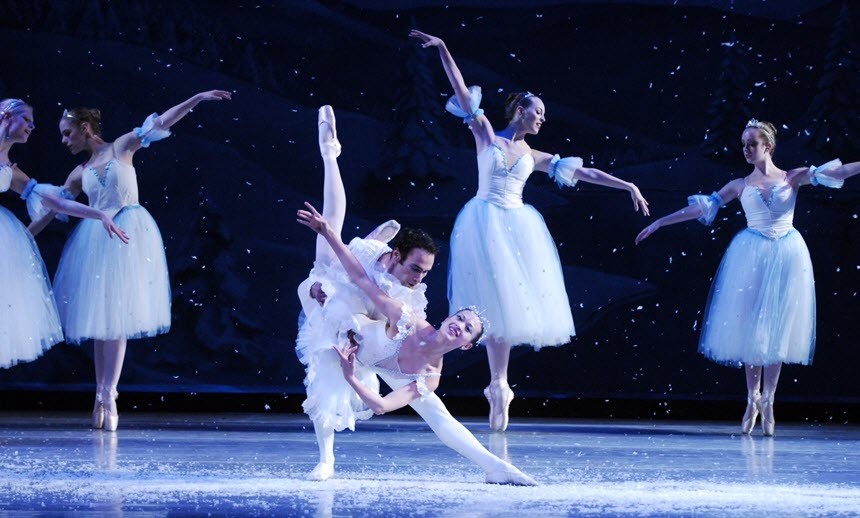
Image: “Ballet” by Distillery Trail.

The Beauty Behind Live Performances

Personally, I think live performances will always be more impactful and worthwhile for me than performances viewed on technology. Going to a theatre and being fully immersed in the experience offers so much that you can’t experience via technology today. For example, when you go to a theatre, you are surrounded by a type of atmosphere you can’t experience from your house. Everyone is dressed elegantly and it creates an ambiance that can’t be replicated. Then, in your seat you are surrounded by an eagerly waiting crowd. You realize that you all have one thing in common: love and passion for live performances and the performing arts. Then, the lights dim and you are immersed into the performance. You are surrounded by booming and echoing sounds as you are watching a beautifully performed live act. The beauty behind a live performance is that each one is unique and cannot be replicated exactly. I think that provides so much value itself in the idea behind live performances. It makes your experience special and it allows for the performers to share something special with their specific audience.

1-3y6A2uLsIrdjD10YimEndQ
Image: “Concert” by hpyebot.com.

Advantages of Live-Streaming

With technology, we have found a new definition of the word “live.” With technology, we now think in terms of “live-streaming.” Live-streaming is the idea that you are watching a performance being performed live somewhere else through the use of digital technology. Many concerts, performances, and other events are now being recorded and people are able to live-stream the events from anywhere in the world! For example,”livestreaming music festivals and concerts are also becoming increasingly popular. In fact, 81% of internet and mobile audiences watched more live video in 2016 than in 2015. YouTube for instance, livestreams large events including Coachella and Ultra, giving new meaning to the concept of seeing a performance “live”.” I think that the idea of live-streaming has quite a few advantages. For one, it makes artists’ work more easily accessible and viewed by a larger audience. However, I still struggle getting past the idea of the audience not truly being able to experience the “live” aspect of the performance as described earlier. In the future, I hope that someone is able to come up with some sort of technology that can continue improving the idea behind live-streaming without completely destroying the art of live performances.

Thanks for reading my blog! Hasta luego, amigos!

Where in the World will Wearable IT Take Dancers?

Hi everyone! In this blog post I am going to discuss wearable IT and dancers’ future with wearable IT.

Wearable IT is one type of a strategic technology trend that allows for a quantified environment. A quantified environment means that one is able to track and record data from the physical environment around you in the form of numbers. Wearable IT is a tactical and incremental technology which means that it is a technology that is still emerging and this field of technology will experience significant improvements in infrastructure and processes in the near future.

Benefits of Wearable Technology

Image: “Apple Watch” by 1 UP Nutrition Athletes.

For example, Apple watches are considered to be wearable IT because you can wear it on your body and it quantifies your physical environment by tracking your movement, your activity, and your heart rate and health. Before wearable IT such as Apple watches or Fitbits, data such as distance walked in a day or steps taken in a day was not quantifiable because there was simply no way of keeping track of all of this data. However, now with the use of Apple watches, users are found to be more motivated to reach daily fitness goals because they can now physically see their fitness and activity levels in their personal environment. This article explores the benefits of wearable IT such as encouraging self-monitoring and personal responsibility which I think is interesting because at first one may not think of this as a benefit of a smart watch. Other benefits of wearable IT include increased personal safety because some smart watches allow for your location to be tracked and known by people you share it with. Furthermore, this type of wearable technology enhances communication through alerting the user of notifications or setting alarms and reminders to complete a task.

While researching how wearable IT might possibly impact dancers in the future, I came across the idea of a wearable sound system. This idea is fascinating to me because dancers who tested this system out reported that they were inspired to move in new ways because they could hear the music better and they could feel the vibrations from the sound system on their body.

Wearable e-traces ballet shoes

Image: “E-Traces Pointe Shoes” by Sam Draper.

Another interesting wearable IT I discovered is called E-Traces pointe shoes. These are a type of ballet shoe that captures the movement and pressure of a dancer’s feet and transmits that data to an app where it can be viewed graphically. It is so interesting how the foot pressure and movement of a dancer can then be transformed into a visual art. Below is a video showing an example of this amazing wearable IT in action!

Video: “E-Traces, Memories of Dance” by Lesia Trubat.

Another interesting type of wearable IT for dancers are these bodysuits with different colored lights. This wearable IT enhances the viewers experience by adding another visual layer to a dance performance. The lights can be programmed to correspond with changes in motion and music and it is a really cool form of wearable IT! This type of wearable IT is typically seen in hip-hop dances, but I think that as wearable IT continues to become more popular, it will be used in other styles of dance as well. Click this link to see a video of an example of this kind of wearable IT!

As someone interested in big data, I am very excited and interested to see how wearable IT increases the amount of quantifiable environments we have. I think that as the number of quantifiable environments increase, the amount of big data we analyze will also increase because it will be easier to have access to even more types of data that is produced daily by people all over the world through wearable IT.

This upcoming summer I am interning at PricewaterhouseCoopers, and I came across this article that mentions a PwC report discussing the idea of wearables: “for wearables to be most valuable to the consumer, it needs to embrace Internet of Things (IoT) opportunities; transform big data into super data that not only culls, but also interprets information to deliver insights; and take a human-centered design approach, creating a simplified user experience and an easier means to achieve goals.” I think that this shows insight into how wearables are truly meant to be designed to cater to the user while also embracing the ideas of big data and the Internet of Things. Not only is the consumer market going to see large increases in wearables, but also the business to business market.

Overall, as a personal user of an Apple watch, a form of wearable IT, I cannot wait to see improvements and advancements in wearable IT. I think that wearable IT is going to become even more standardized and used in every day life by even more and more people. Until next time my friends, adios!

Professionals 2.0

One of my favorite professional dancers to follow is Peta Murgatroyd. She is a professional dancer on Dancing With the Stars and also is an actress. I admire her Instagram account because I believe it is a good balance between sharing professional and personal parts of her life. In general, her posts are either about Dancing With the Stars, the movie she is starring in called Faith, Hope, Love, promoting health and exercise, sharing her fashion style, posting about her love for her family, or advertising her newly founded tanning products and skincare brand. I enjoy her social media page because her posts are authentic and her photos are not extremely edited like many celebrities’ photos are. All of her content is original with the exception of a few posts about partnerships with companies such as FabFitFun. I enjoy her page because I love to follow dancers and I am particularly inspired by her choreography and choices of costumes. It seems as if she uses her Instagram account to post happy and authentic moments in her life as well as promoting certain brands or topics, such as health and exercise, that she clearly values and focuses on in her life. 

Peta posts on her account every few days and the topics of her posts range daily. On Instagram, she has 1,477 posts, 814,000 followers, and is following 211 accounts. Below is her biography and you can see immediately how she promotes her acting and dancing careers, her skincare products, beauty and style, and values her family.

E35D662E-F5F5-425B-A382-B403B4D9C3BC

Image: “Peta Murgatroyd’s Instagram” found on Instagram.

Below is her account on Twitter. She has 236,800 followers and is following 4,673 accounts. I think that it has a similar digital identity as her Instagram does. She markets herself, her brands, and her interests well and her profiles give off a fresh and interesting image. It is clear to see that she is interested in promoting herself in the dance business because she has posted links for her websites and has details about how to contact her for business inquires.

09150241-DD1E-4606-9360-B6638DE46CC3

Image: “Peta Murgatroyd’s Twitter” found on Twitter.

One thing that I could do better to improve my digital identity would be to post the link to any websites I have in the biography of my accounts. That would allow for people viewing my accounts to see all of the work I have done and I may be more marketable that way. Overall, I really enjoy how Peta’s accounts have a good balance of both professional and personal aspects and I think that is a good digital identity to have. Also, if in the future I ever create something that I would like to promote or if I am interested in being contacted for business, I think it would be beneficial to list an email to be contacted at. Moving forward, I will try to follow this model on my accounts as well.

Megan’s Personal Learning Environment

Hi everyone! In this blog post I am going to discuss what a PLE is and what mine includes specifically.

A PLE is a Personal Learning Environment and includes various forms of technology that we use to learn each day. At first, one may think that they don’t use anything on a daily basis to “learn,” however, we learn in many different ways. I believe that my PLE can be attributed to the following topics: communication, finances, education, organization, creation, health, entertainment, and information. All of these aid in my daily process of learning and allow me to grow as an individual. Furthermore, I think it is most important to begin with discussing what specific resources allow for me to develop my PLE. Below is a diagram I created to define my PLE.

PLE

Image: “Megan’s Personal Learning Environment!” by Megan Svara. License CC BY-ND.
(All icons used to make this image were retrieved from Apple, license All Rights Reserved.)

On a daily basis, I use my iPad, my iPhone, my Apple Watch, and my HP Spectre x360 laptop. These resources aid my learning process and allow me to access any type of information that helps me learn. I mainly use my iPhone to communicate, manage my finances, maintain my health, and look up information. My iPad is mostly used for education, organization, creation, and entertainment. I use my Apple Watch to communicate and keep track of my health. Finally, my laptop is used for organization, creation, entertainment, and information.

Before diving into the specifics on what I use to learn, I think it is important to acknowledge the fact that I tend to learn much of what I know from those around me. Personally, I can accredit most of my success in the mathematics field thus far to my Papa and Dad. They have always encouraged my interests in mathematics and have helped me improve my problem solving and critical thinking skills. From as long as I can remember, I would go over to my grandparents’ house and my Papa would always quiz me on my addition, subtraction, multiplication, division, roots, and then review what I was learning in school. I think that the people around us impact what we learn and how we learn and I know for a fact that I would not be nearly as interested or good at mathematics as I am now without my Papa and my Dad being apart of my Personal Learning Environment.

For learning by communicating with others, I use Facebook, Instagram, Outlook, Facetime, Snapchat, and GroupMe. With these resources, I am able to connect to my friends and family members, especially in circumstances like this semester where I am abroad and do not have daily physical contact with them. I tend to find and share a lot of information on these media platforms and believe that without them I would not be able to communicate efficiently or effectively. They offer and support collaborative learning and that is crucial for my learning process because I tend to learn best by the use of communication and collaboration.

I have recently opened up a financial portfolio with Charles Schwab and have found that the app and website have aided in my learning about stocks, financial portfolios, and finances in general. Also, the Bank of America app is extremely useful to me because I am able to track my spendings and savings at my fingertips. It allows for me to be more aware of my finances constantly and helps me make smart financial decisions. This type of learning is not only important in everyday life, but is also applicable towards my future career as an Actuary. In my classes at the University of Iowa, I have learned about different types of financial portfolios and know how to calculate their values, but now as an investor these platforms allow for me to learn about the same topic from a different perspective as the buyer.

For education purposes, such as school work in the United States, I use the Canvas Student App and Quizlet. Canvas helps me easily access school work, assignments, grades, and I can communicate with professors on it. Also, on Quizlet, I am able to create study guides before quizzes or exams.

To organize all of my photos and documents, I use One Drive, Google Drive, Google Photos, and Windows File Explorer. I think that organization is key when it comes to learning. Once you learn something, you want to be able to easily access it again, so these tools help me store and recall things that I learn. If I am not organized, I know that I will not learn to my fullest potential, so these resources are crucial in my PLE.

When it comes to creating items to learn, I use Microsoft Word, Microsoft Excel, Microsoft PowerPoint, GoodNotes, and Rocketbook. For school, I always write my essays, projects, and presentations in Word, Excel, and PowerPoint. During classes, I use GoodNotes on my iPad to hand write notes electronically. Also, I use Rocketbook to scan and upload notes that I take in my reusable Rocketbook notebook in order to organize them in Google Drive. These five medias are crucial in my creativity process, and I actually made the above diagram of my PLE in GoodNotes on my iPad. I have recently converted from taking notes on paper to my iPad, and I believe that this has been beneficial to my learning. All of my notes are stored and saved in one location so it is much easier to access and recall information I have learned.

I find that the MyFitnessPal app along with the Activity app allow for me to keep track of my fitness and health. These apps can track my calorie intake, my daily exercise, and they encourage me to focus on fitness. Also, I can look back on progress made because they store information daily. When college began, I noticed a decrease in my physical health. However, these apps have allowed for me to hold myself more accountable and make health a priority once again in my life. I do not think that I would be nearly as knowledgeable or conscientious about my health if I did not have this technology to help me.

For entertainment, I use Netflix and the ABC app. I enjoy watching movies and television series on these platforms and relax by watching shows on these apps. I consider this a part of my learning process because these platforms allow for me to take a break from serious learning and feel refreshed when returning to learning.

Finally, for finding information, I typically use Google, YouTube, and Pinterest. These platforms are easy to use for creative projects, research, and looking up music and dances. Over the past 19 years as a dancer, I have constantly used Google and YouTube to research types of dances and learn new dance forms. Dance is my hobby and my passion, and without Google and YouTube, I would not be able to easily learn more about dance.

I think that technology is crucial to learning and it can allow for everyone to personalize the way they learn and it can cater to a variety of learning abilities and needs. I found an article titled “Weighing in on Technology and Personalized Education” and thought that the following quote was extremely powerful and true, said by Shawn Mahoney, Ph.D.: “Personalized learning gives students more opportunity to become architects of their own learning path as the technology adapts to their specific needs.” Also, a quote by Eric Sheninger states that with technology “students crave a greater purpose and sense of relevance in their learning.” I find personally that when I am able to use technology to aid in my learning process I tend to retain more information and have a greater interest in the topics I am learning.

Overall, I think that all of these devices, platforms, apps, and websites make up my PLE. I think that my PLE has recently expanded since beginning college, and I think that it will continue to develop during my time here in Spain. Personal Learning Environments are unique to each person and evolve continually because we continue to grow and learn in different ways. I hope you found this blog interesting and that it inspires you to think about your PLE and how you learn and grow on a daily basis. Hasta luego, mis amigos!

 

Web 2.0’s Significance and it’s Impact in the Dance World

Hello all and welcome to my first blog post! This blog post is for my class at IES called Management of Digital Identities and Technologies. Here, I will be explaining what the term “Web 2.0” really means and how it impacts the lives of dancers.

What is Web 2.0?

According to Tim O’Reilly’s article, there are differences between Web 1.0 and Web 2.0. With Web 2.0, there has been a vast increase in the amount of user participation on the internet. Web 1.0 only allowed users to be consumers of information provided on the internet, however, Web 2.0 encourages creative collaboration among users, and it inspires users to contribute their own ideas and information. This collaboration can be seen on social media platforms such as Instagram, Twitter, and Facebook, along with blogs (just like this one!), websites, apps for smartphones, and pages like Wikipedia. The Web 2.0 is a platform that supports participation from all users and this participation is much easier accessible now that more and more people are owning their own personal computers, laptops, tablets, and smartphones. These devices allow for endless amounts of use, participation, and viewing at any moment. This Web 2.0 allows for infinite amounts of collective intelligence to be harnessed on the internet, which, I find quite fascinating.

Can Web 2.0 be trusted?

With nearly all of the information published on the internet being from people just like you and me, the question of whether the information can be trusted or not quickly arises. I believe that the answer is yes. The advantage of the Web 2.0 is that there are various types of websites found on the internet. The credibility of websites can easily be identified based on the type of website, how professional and organized the information appears, and if the ideas presented are cited and have information to back these claims up. One of the most popular ways on the internet to cite information discussed is by the use of hyperlinks. Hyperlinks were not available on the Web 1.0, and they are more useful than you may realize. Hyperlinks appear on every webpage and allow for users to further participate by connecting various ideas from various people and sources. For example, the topics I am discussing here relate directly to the article by Time O’Reilly that I hyperlinked in the section above. By me writing this blog, I am further continuing the collaboration on the topic of Web 2.0 that has been previously published. I find it so interesting that I have the ability to contribute my thoughts on the internet and that others interested in these topics can read and react to my ideas from anywhere in the world.

Also, another advantage of the Web 2.0 is the ability to edit the information online. As our world is constantly evolving, it is convenient that we have the ability to update things published in the past. For example, Wikipedia is a website that clearly conveys the advantages of the Web 2.0. Information posted on Wikipedia can be added and edited by any internet user. This prospect can be seen as risky, but it really is just an experiment of trust. Because a site like this can be edited at any time, it has been found to be a pretty reliable source of information because there is a decrease in the amount of bias on a topic because more and more users have the ability to control and regulate the information published. Also, another advantage of this site is that because information can be edited, you can always view the history of the information on each topic. The storage of the data from the past is truly important because if you are wanting to do research on a certain topic over time, you can easily access the information posted on Wikipedia at any time throughout history. I find this ability to be such a revolutionary idea and hope that the web will always be an open platform that encourages user participation and collaboration. For example, if you looked up ice cream on Wikipedia, you can see current information about it along with information about it from the past. I think this is a pretty cool feature!

wikipediaImage: “Wikipedia” by Wired, license All Rights Reserved.

Why does Web 2.0 matter?

I believe that the Web 2.0 can truly be seen as a form of art from this time period. The way we have been able to understand and learn about history in the past was through documents and pieces of art produced during that time period. I believe the Web 2.0 is a piece of art that will be looked back at in the future by people who are trying to understand what life was like during our time. Because such a large proportion of the world has easy access to the internet, more and more people are collaborating in some way or another, and this is in fact a beautiful thing that makes our time now unique. People are able to easily express themselves on the internet, through pictures, words, videos, music, and more, and the internet has continued to shape the way we learn, interact, and grow as a generation.

How does Web 2.0 impact dancers like myself?

A dancer like myself may wonder how Web 2.0 can and does impact our lives dancing. An article in Dance Magazine by Zachary Whittenburg clearly discusses how online videos have impacted the dance world.

Generally, I enjoy the fact that I can so easily access and watch dance videos on the internet because it can aid in learning new types of dances. I think that it is inspiring to see that so many dancers are wanting to participate online and share their work on Web 2.0. However, there is one major downfall to sharing work on Web 2.0 and that is the potential for your work to be copied by someone else.

One controversial example of this is BeyoncĂ©’s music video for her song called Countdown. At first look, it is inspiring and looks innovative. However, it was brought to attention that a specific scene seemed to copy the work of Anne Teresa De Keersmaeker’s Rosas danst Rosas. Below is a video comparing the scenes of the two videos side by side.

Video: “BeyoncĂ© vs. Anne Teresa De KeersmaekerBeyoncĂ© vs. Anne Teresa De Keersmaeker” by Studio Brussel on YouTube.

From this video, I think it is evident that BeyoncĂ©’s work clearly imitates the moves in Rosas danst Rosas. Not only the moves are the same, but the costumes and scenes are the same as well. However, the question is if BeyoncĂ©’s video is simply inspired by Anne Teresa De Keersmaeker’s work or is BeyoncĂ© plagiarizing? This is one scenario that illustrates the impact of online videos on the dance industry.

Overall, Web 2.0 raises many questions and concerns about plagiarism in the dance industry and beyond. However, it seems that Web 2.0 has many positive impacts and it will be interesting to see how the internet continues to progressive and evolve!

Finally, I am grateful for the ability to participate on the Web 2.0 and can’t wait to see where the internet goes next! Until then, I hope you all enjoyed this article and continue to collaborate online as much as possible! It is a privilege and I am looking forward to continuing my collaboration through this blog with more articles to come soon.